What AI Taught Me About the Mind
What AI Taught Me About the Mind
I was thinking about my work with AI recently, and it changed how I think about my own mind.
The shift was simple, but strange. I started to realize that my mind is not some magical mystery box. It is more like a filter. Information comes in, then my brain runs it through rules, habits, values, fears, past experiences, and a bunch of patterns I only partly understand. Some of those rules are obvious. Some are buried a little deeper.
That idea only clicked because I had already started doing the same thing with AI.
The solution
I had been feeding my own AI tools little text files full of preferences, rules, writing habits, and ways I tend to think through problems. Then I tried something more direct. I asked Claude to map the way I seem to process information and summarize the rules and frameworks behind it.
It was accurate. Uncomfortably accurate.
Nothing builds character like being summarized correctly by a machine you were only half taking seriously.
That turned out to be useful because once you can see the filter, you can work with it instead of being quietly run by it.
A simple way to do this is to keep a plain text or .md file with things like:
- what matters to you
- how you make decisions
- what you tend to ignore
- what kinds of answers annoy you
- what kinds of problems you overcomplicate
- where you usually need to be challenged
Then you give that file to your AI tool as reference material.

Caption: Opening Project settings inside a ChatGPT project so you can add project-specific instructions.
Source: OpenAI Help - Projects in ChatGPT

Caption: Claude Project knowledge, where you upload reference files so the AI can answer with your material in mind.
Source: Anthropic - Collaborate with Claude on Projects

Caption: Claude custom instructions inside a project, which is one way to tell the AI how you want it to think and respond.
Source: Anthropic - Collaborate with Claude on Projects
Now the AI is not just answering random prompts. It is answering in a way that matches how you actually think.
When this works
This works well if you use AI often for writing, planning, problem-solving, journaling, or sorting through ideas. It is especially useful if you feel like your best thoughts come out in fragments and you want the machine to help organize them without flattening them.
It can also help you notice patterns about yourself that are easy to miss when you are living inside them.
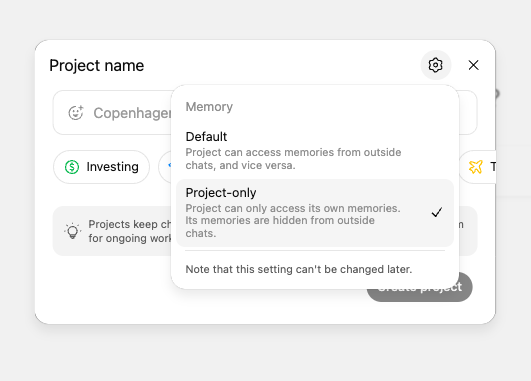
Caption: ChatGPT project-only memory, which keeps context inside one workspace instead of mixing it with everything else.
Source: OpenAI Help - Projects in ChatGPT
When it does not
This can go sideways if you build an AI that only agrees with you.
That is not personalization. That is a very polite echo chamber.
If you do this, add some contrarian logic. In plain English, that just means telling the AI to challenge weak assumptions, point out blind spots, and say when your reasoning does not hold up. Otherwise, it will happily tell you that every idea is brilliant, which is nice for about five minutes.
Nice is not the same thing as useful. A smoke alarm that compliments the kitchen is not doing its job.
Bottom line
The mind is not just a source of thoughts. It is also the system that filters them.
AI can help you see that system more clearly. And once you can see it, you can start shaping it on purpose.
Ask AI this
"Based on my writing, decisions, and the way I explain things, map the rules and frameworks I seem to use when I think. Show me which ones help me, which ones limit me, and where I may have blind spots. Then turn that into a simple text file I can reuse to personalize AI tools."